Tuesday, May 13, 2014

Did the PSU Board of Trustees plan the consent decree in advance?

As we approach what could be a banner day in the saga of the Jerry Sandusky scandal I came across an email in Ryan Bagwells document database that caught my eye. As most of us know the Freeh Report was released on July 12, 2012 and the NCAA sanctions came down on July 23, 2012. In the interim reports began to slowly trickle out about impending doom via several outlets. You can see an example here via ESPN on July 17, 2012. Other examples of contemporary stories are here, here, and here.

Tellingly in the ESPN article is this statement:

Emmert also said that he expects to hear back from Penn State "within weeks" regarding questions the NCAA has issued about the case, including the issue of institutional control. He consistently has maintained that the NCAA will not determine whether violations occurred until receiving the school's response.

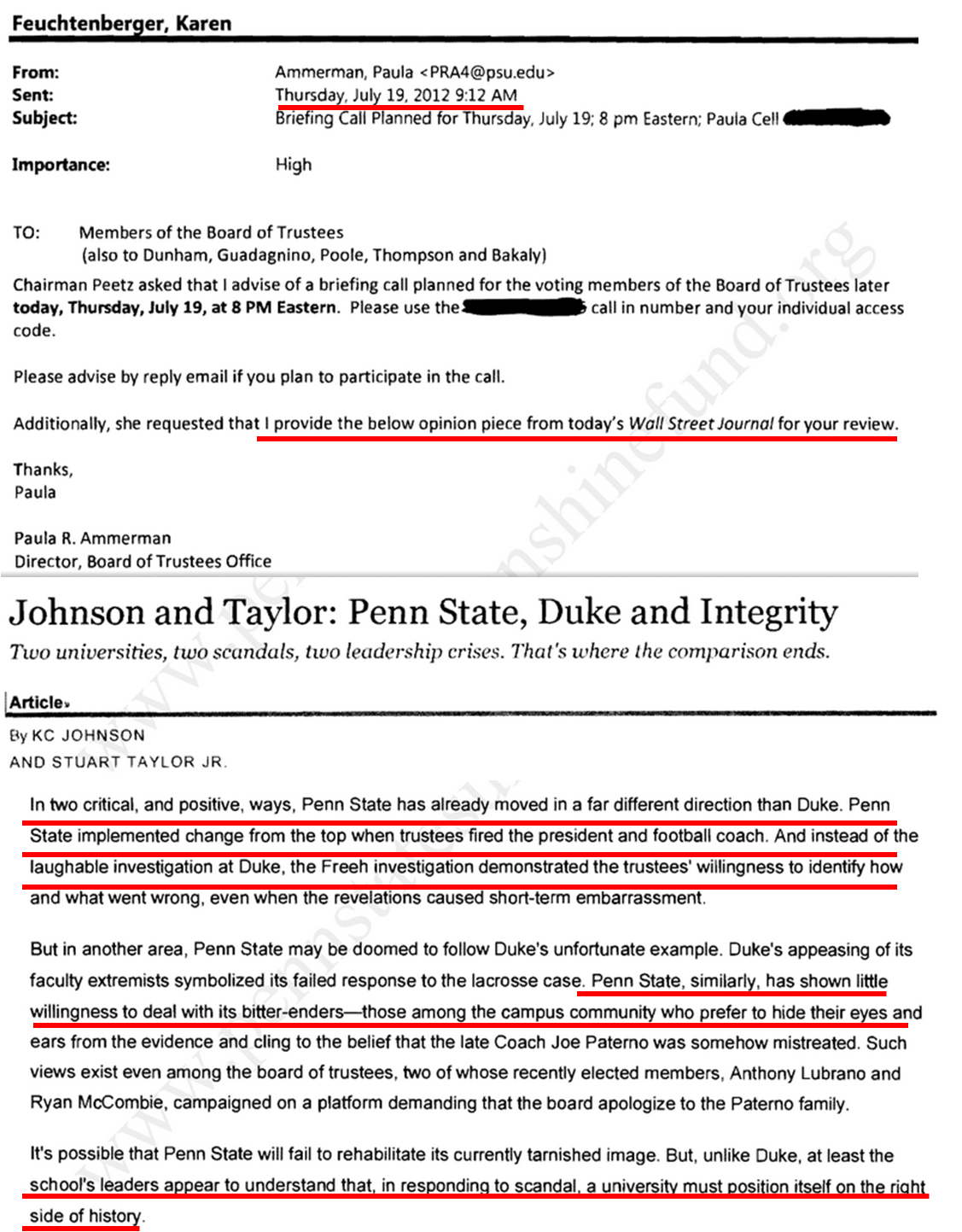
Notice the timing there. "Within weeks" and "until receiving a response" were used by Emmert. Yet 6 short days later came the most destructive sanctions in the history of NCAA sports. In the interim PSU released no official letter, report, or review of the Freeh Report to determine it's reliability on the issues. However take a look at the email I linked to. The email is marked "high" importance and asks all voting members of the PSUBoT for a briefing call no later than that day, and included a story on the Duke Lacrosse scandal and the public relations of such situations.

Here is a screen capture of the most important parts, my emphasis added.


Now many know that at the time the discussion at PSU had started to center around Joe Paterno's statue at Beaver Stadium. Calls had begun to remove the statue after Louis Freeh made his defamatory and laughable conclusions in his report. Just three days after this briefing call the statue was removed, and the very next day the NCAA hammered PSU with unprecedented sanctions. 

What is curious is the need for a briefing call for all voting members rather than just the executive committee, or any briefing at all. The statement released by PSU clearly states that Rodney Erickson made the determination on his own about the statue. 

I now believe that, contrary to its original intention, Coach Paterno’s statue has become a source of division and an obstacle to healing in our University and beyond. For that reason, I have decided that it is in the best interest of our university and public safety to remove the statue and store it in a secure location.
So what was this briefing call for? Why did they need all voting members? Rodney Erickson and the board claimed they did not need the board to vote on the sanctions so why did they need to include voting members for removing a statue? Ron Tomalis inquires in a further email asking if it is about the statue, and that since there is no vote it won't be covered by the Sunshine act. But why? No vote need be taken, and why include the article on Duke?

When you put it in the bigger picture I have to wonder what was going on here. The NCAA has explicitly stated they might take weeks to respond, and can do so formally as a response to the letter of notice sent at the outset of the Sandusky scandal in 2011. This was the normal procedure for an NCAA investigation, and it could have dragged on for years. Yet just four short days later Erickson signed away PSU's rights in the worst deal ever recorded in NCAA history. Why? What was discussed on this briefing call? Since no vote was taken there was no recording made. Was caving to the NCAA considered and discussed to appease the media and drive PR to "position itself on the right side of history"(based on a precedent from a case that did not turn out as reported as well)? One has to wonder. One also has to wonder how the PSUBoT keep ending up on the wrong side of history.


Sunday, April 20, 2014

The Obfuscation of Jerry Sandusky

My last post looked at whether Dottie Sandusky, wife of Jerry, really believed in his innocence. Today I want to use information gleaned from Jerry's words himself to analyze why she had good reason to doubt her husband's innocence. Some of this information is taken directly from Jerry's mouth in his prison interview in early 2013. There is also evidence from other interviews like the one by Jo Becker of the NY Times, along with testimony in court by professionals of Jerry's psychological profile.

Let's start with an incident most people who follow this case, and many who don't, know about. Early on after Jerry's indictment he called in to an interview with Bob Costas. The interview starts off normal enough, with Jerry stating "I am innocent of those charges".

However shortly afterwards there are questionable responses to some other questions. Shortly into the interview this exchange occurs:
Costas: During one of those conversations, you said, "I understand, I was wrong, I wish I could get forgiveness," speaking now with the mother. "I know I won't get it from you. I wish I were dead." A guy falsely accused or a guy whose actions have been misinterpreted doesn't respond that way, does he?
Sandusky: I don't know. I didn't say, to my recollection that I wish I were dead. I was hopeful that we could reconcile things
I find this exchange curious. Sandusky's response is that he didn't  recall saying he wished he were dead. He did not dispute that he was wrong, or that he needed forgiveness. He was hopeful to "reconcile" things. If he did nothing wrong what was to reconcile? It also casts doubt on Dottie's implication that it never happened, as Jerry does not deny the conversation took place.

Then we come to the most infamous exchange of the interview. Costas directly challenges Sandusky with the following question:
Costas: Are you a pedophile?
Sandusky: No
Costas: Are you sexually attracted to underage boys?
Sandusky: Am I sexually attracted to young boys?
Costas: Yes
Sandusky: Sexually attracted, you know, I enjoy young people. I love to be around them. But no I'm not sexually attracted to young boys
Sandusky repeats the question/statement twice and doesn't say no to sexual attraction until his third sentence in the second answer. Do you find that strange? In the audio it is even worse. You can hear the pause, feel the searching. Luckily for us Sandusky addresses this exchange in his prison interview from early 2013.

On page 82 of his prison interview, Jerry tells us the story of the Costas interview, more specifically of that question. When asked why he hesitated when answering that question he states:

Sandusky: So I was not expecting anything like that. When that question was asked I’m
thinking my thoughts all were on what I call the victims of this. I was thinking
about all the people that gotten hurt. My frame of reference was not whether or
not I was sexually attracted to boys. Ok, my frame of reference was all these
people that were going to get hurt. My frame of reference was to always to try
help. I didn’t think in those kinds of terms. I was taken aback. I’ve never been
asked anything like that in my life. I said to myself, I want to be honest. I want to
clear. I want to be fair. And when he asked the question, I was trying to think in
my mind, is he saying do I like young people? You know, what is he saying? I
was trying to get it into my mind. Yeah, I love young people. I enjoy..My two
favorite groups are the young and the old. One doesn’t know any better and the
other just doesn’t care. So those kinds of thoughts were going thru my mind. It
really didn’t even register with me that that would be a question to ask.... I don't
know.
There are a couple of real telling points in there. Is Sandusky actually trying to make us believe that after being arrested for alleged rape and molestation of children over decades that he never expected a question about his sexual attraction? That just doesn't stand up to any logic or scrutiny. Secondly Sandusky is implying somehow that the question was confusing, when it was quite clear. Lastly is his description of the two groups of people he loves. Look at what he says about the young. "One doesn't know any better". Exactly the kind of trait which makes them easy prey. Combine that with the following paragraph from the interview on page 81:


So the young "don't know any better" and when you choose disadvantaged and troubled young you have easy ways to raise suspicion about their claims. 

These signs of guilt and hesitation are evident in other interviews as well. If you look closely at the interview with Jo Becker, around the 4:00 mark you can see the hesitation in answering. You can see the inability of Sandusky to make eye contact. He looks down, he looks away. He looks everywhere but at the interviewer when answering about details in regards to the 2001 case. 

A little later in that interview Sandusky has to actually be interrupted by his lawyer to clarify something he says. Examining the interview around the 7:00 mark he discusses the Costas question and again claims to be caught off guard. He then explains that he is "attracted" to young people, both boys and girls. However his lawyer quickly interjects from off camera "not sexually". Seems once again Sandusky left some doubt there as to his true feelings.

Looking a little more at Jerry's prison interview certainly provides us with other nuggets of inconsistency and consciousness of guilt. The first one comes very early on page 3. In discussing the parameters of the interview Jerry states that one issue is "I don't want to incriminate myself". Incriminate yourself of what? You are claiming you didn't commit any crimes. That is an interesting statement from an "innocent" man. However when you read the interview closer you can see why he might have said that.

On page 40 Jerry steadfastly refuses to give out the name of alleged Victim 2, but then goes on to describe enough detail to make it fairly easy to track him down. Sandusky offers multiple details about his high school graduation, wedding, his senior football season at high school, and after Ziegler moves on offers up "He's in the marines". Does that sound like Sandusky trying to hide his identity?

Why might Sandusky want this man found and publicized? Perhaps it's because Sandusky had already met with this alleged Victim 2 in the summer of 2011. Yes, Sandusky had been in contact with multiple witnesses against him in the trial. Was this an attempt by Sandusky to elicit information about what they might say or perhaps an attempt to shade their testimony his way? Maybe Sandusky knows that he didn't abuse the victim that night in 2001, but had on other occasions. Perhaps Sandusky knew anyone finding this victim would muddy the case against him at this point. Either way it's pretty clear he had no issue with people "finding" this victim. His lawyer though is on record publicly saying he has doubts this is truly Victim 2. 

Another red flag regarding Victim 2 is Sandusky's version of how Tim Curley contacted him about the 2001 incident. On page 50 of the prison interview Sandusky concedes that he denied the incident originally in 2001. When asked why he states:

Sandusky: Because I didn't know what I did. I was trying to figure out who was in the shower with me or whatever.

Remember Sandusky has steadfastly said he never did anything wrong. So regardless of what you did, why would you deny that you were in that shower if you did nothing wrong? Is it because unlike what you state in other parts of the interview you indeed knew that 1998 was a big deal and if you were caught in the shower again it would cause suspicion? Or is it because you had taken multiple boys into the showers in this time frame and you were honestly trying to remember which one it was and what you had actually done? 

With regards to his initial denial Sandusky seems confused about whether he immediately changed his tune or if it was at a second conversation. This would be a key point because if there was any amount of time in between it would give ample opportunity for Sandusky to speak with Victim 2 and get his story straight. 

When analyzing further Sandusky's claims about his memory and whether we should believe it we can also look at the identity of the witness to the 2001 incident and how Mike McQuery came to be known as that man. The first stop is page 38 of the prison interview. There the following exchange takes place:

Ziegler: So Tim Curley never told you it was Mike McQuery?
Sandusky: No. Tim Curley said it was a man or a woman (laughter). 
To those following the case this should be a golden nugget that Sandusky is lying and trying to cast doubt on others. At no time has anyone, not Curley, Schultz, Spanier, Paterno, or the OAG ever stated that the witness was a woman, ever. That's a pretty big detail to mess up. So big that it is impossible to believe Sandusky actually believes it. The only possible way this could be true is if the rumors that Sandusky was witnessed in other buildings with kids are what Sandusky is melding with the 2001 incident with McQuery. 

Additionally Sandusky then clearly in his interview lies about when he knew it was McQuery who was the witness. In fact Sandusky waffles several times on this. On page 66 is the exchange below:


If you look closely there you will see that Sandusky first implies that McQuery's name came out when Curley, Spanier, and Paterno's did. Then he backtracks. According to several local contacts I have spoken to it was common knowledge around town though that McQuery was "the GA" for a while prior to the indictment so it's likely Sandusky knew this already and is just looking for a way to claim he didn't. 

Additionally he waffles back on forth on when he even knew there was a grand jury. First he claims he didn't know until June 2011 (page 63). Then he changes it to "spring" of 2011 on page 65 and this is because his son Matt testified. Then you can see the exchange above where he professes to know of the March 2011 Ganim article, specifically for use of the term GA. So here we again have obfuscation of the timeline by Sandusky. Perhaps he is remembering incorrectly, which could be the case. However others are asking us to trust that he is the one recalling memory from 2001 about Victim 2. It seems more likely to me that OAG had already at this point found the notes on the file and knew the correct dates. 

I am not a professional psychologist. I have no professional training in behavior or psychology. So you don't have to trust just me, you can trust the professionals who examined Sandusky for his trial. They are very interesting, especially in light of the fact that Sandusky refuses to delve into the results of a lie detector test he took. John O'Brien testified to the results of psychological examinations of Sandusky on June 19, 2012 . His words are telling:


Notice the consistent theme. Sandusky is trying to bias the tests, and doing so by portraying himself in a more favorable light, or overly positive terms. This is a consistent theme if you analyze his words in his interviews too. He always says he was trying to help the kids, or be family. He never acknowledges truly how what he is doing may be harmful, or that it should be concerning since he was warned. Dr. O'Brien tells us that Sandusky fit two possible profiles.


Those two profiles he fit best are histrionic personality disorder, a disorder characterized by emotional excess, attention seeking behavior, flirtatiousness, and inappropriate seductive behavior. The other is narcissistic personality traits, a condition which can be described as one "in which a person is excessively preoccupied with personal adequacy, power, prestige and vanity, mentally unable to see the destructive damage they are causing to themselves and to others in the process." (my emphasis added). His narcissism is surely evident on page 45 of the jailhouse interview where he speaks of himself in the third person. 

When you add it all up you see a picture of a man trying to obfuscate the truth. Delusional to the point of destructiveness, and concerned with portraying himself in the best possible light. He uses lies, half truths, misdirection, and the weakness of his victims to do so. He is so concerned about portraying himself in a positive light that he ignores the wide swath of destruction he has left behind. Everyone is out to get good ole Jerry. Jerry has never done anything to hurt anyone. Jerry says so. Don't believe it. 


Tuesday, April 1, 2014

Does Dottie Sandusky REALLY believe Jerry is Innocent? What her Interview with Matt Lauer can tell us.

Much has been made of Dottie Sandusky's recent round of TV interviews, mainly with Matt Lauer on the Today Show, trying to argue for her husband's innocence. Many people have focused on why she said what she said or acted how she acted over the years. Some think she had to know who her husband was, some think she is in denial. I wanted to take a different angle today and focus more specifically on what she said and what we can glean from it. Dottie went on TV with her best poker face, but at the same time she did reveal some tells. 

The man who sat by Dottie's side, self-proclaimed "documentary film maker" John Ziegler, has been vociferous in his defenses of Dottie. He states that for the victims to be telling the truth that Dottie has to be lying. So let's use Dottie's own "testimony" here to evaluate her claims and the "truth-seeker's" failure to correct the factual record.

Unfortunately there is no official transcript of the Today show video which began her tour but you can view it online in it's entirety here to see for yourself.

The first very important exchange occurs around the 14:50 mark:

Lauer: So what was it like to sit in that courtroom and hear story after story after story leveled, and charges, leveled against your husband?

Sandusky: Because I knew that the majority of the stories were not completely true.


This is key. It is key for the simple reason that Dottie Sandusky never heard those stories leveled by the accusers in that courtroom as she only attended the trial the day she testified, which was long after the victims had done so.


 When questioned on Twitter about this topic Ziegler simply stated it was "meaningless error":


So is it relevant that Dottie and Ziegler allowed it to be implied she personally listened to the accusers charges first hand in court when she didn't? John would never stand for such a lie to go unchallenged if it hurt his argument but here he did because it helped him. As an expert (supposedly) in "media malpractice" Ziegler knows full well why this is an important point, optics and perception. Viewers would think that Dottie was there cheering on her man from day one, all the time, against these lying kids. 

Why did Dottie and Ziegler think it was "meaningless" that Dottie did not show up to support her husband? Perhaps it's because viewers might reasonably conclude that Dottie's absence is a tell that she knew her husband was guilty? If she truly believed her husband's innocence she would be there front and center in court, right? I really wish Matt Lauer would have had this correct and could have pressed this point. A great question would have been "Why didn't you support your husband by coming to his trial?"

This was not the only instance of troubles with what Dottie said to Matt Lauer.

Starting at the 37:00 mark of the interview is this exchange:

Lauer: Can you give me an example of something that he told you that he was truthful about that hurt? What were you referring to there?

Sandusky:  Gee that's hard to decide. To say. Of the...I can't really think of anything.  He told.. I guess..maybe it was the 98 incident.  He told me about that. He told me exactly what happened when that happened. 

Lauer: What was your reaction when he told you about showering with that young man in 1998?"

Sandusky:  didn't think anything about it because he showered........he showered with our kids."

Notice how Dottie answers the question about what hurt her with Jerry telling her "exactly what happened" about the 1998 incident but then quickly switches to saying that she "didn't think anything about it". Which is it, did it hurt or did you not think anything of it? If this was "who Jerry was" and he was doing nothing wrong, why would it hurt when he told you?

The exchange continued:

Lauer: One of the victims said he showered with him and hugged him. In the shower, while they were naked in the shower. Someone did that to one of your children and your children came home and told you that, wouldn't you think that's inappropriate?  That's hugely inappropriate.

Sandusky: I would. Yes, but, I would..I...I..I don't necessarily know that that happened. And maybe it did. Maybe Jerry said (trails off).

So what originally was "he told me exactly what happened" about 1998 ends up morphing to "I don't necessarily know that that happened". Is Dottie trying to convince us of her husband's innocence here, or herself? Initially the story she was told by her husband "hurt" and then became something that didn't happen. This is a massive contradiction. Is this a woman trying to rationalize her husband's behavior, behavior that he admitted to? 

The next exchange which raises eyebrows begins at 46:19: 

Dottie: The department of whatever it is, the department of..I don't know the title [Department of Public Welfare]. They...they came in and they checked into it, and they said that there was nothing to it. 

Of course if, as Ziegler claims, Dottie (and himself) knows more about this case than most she must certainly know that this is a red herring and always has been. On this point Dottie is misleading in two aspects. First the only trained, licensed psychologist to interview the child in this case, Dr. Alycia Chambers, did indeed sound the alarm of abuse to the state agencies in 1998 in her report. Second, the investigator who lead that case, DPW's Jerry Lauro, has stated on record that he would have made a "different decision" if he had seen Chamber's report.  Third, University Park police Detective Ronald Schreffler testified that he felt there was enough to bring charges in the case. And finally, Sandusky was in fact convicted for 3 crimes for that incident at his June 2012 trial.

If Dottie truly is as knowledgeable about the case as Ziegler claims, then she would know that 1998 was incorrectly decided at the time. Even the person who at the time indicated no finding now says he was wrong, perhaps he might say "with the benefit of hindsight"?

The other red herring that is used by Zielger and Dottie is that the 1998 victim continued his relationship with Jerry Sandusky without incident. This is typical behavior among preferential sexual offenders. They gradually test boundaries to make their subjects comfortable. However once concerns are raised the grooming stops. This is exactly what happened with Victim 6. Once the boy and mother raised concerns to authorities Jerry Sandusky knew the boy was off limits for further grooming and abuse. Thus the idea that they continued an abuse free relationship for 13 more years is not indicative at all of the initial abuse. 


All of these items lead one to wonder whether Dottie is being one hundred percent truthful in her statements regarding her husband and his innocence. It certainly goes to the credibility of her information. 

I do have true sympathy for Dottie. I don't believe her to be an evil woman from what I have seen. However, she like many others who  were selected by Jerry, was groomed to believe that her husband's behavior was simply "Jerry being Jerry" when it was really the behavior of a pedophile. I have no idea how hard it must be as your whole life comes crashing down around you and to admit that you were fooled by "The Great Pretender." 

I leave you with one last statement, direct from Dottie's mouth. At the 11:42 mark Dottie states: "The kids say I am very naive". 

Those may be the truest words she spoke the entire interview. 


Wednesday, March 26, 2014

The Dubious Nature of Freeh's Documents - A Pattern

Much has been made of the fact that Louis Freeh and his business seem to be for hire to write reports that fit predetermined outcomes. However in the long and complicated saga of the Jerry Sandusky scandal one possibly more interesting story is the questionable nature of several documents provided as evidence in the Freeh Report. Ray Blehar at www.notpsu.blogspot.com has covered many of these issues but I wanted to expand on the information with some of Freeh's past history regarding documentation of evidence.

Documents in question involve both the infamous "emails" which purport to prove the "conspiracy of silence", including the involvement of Coach Paterno, a letter, and also copies of handwritten notes. Forensic experts have reviewed the published materials that are in question and to date have called them suspicious but inconclusive. To determine the authenticity of the documents they would need the original files and pieces of paper to be sure. From day one of the Freeh Report of course all parties invested in the "PSU Footabll enabled Jerry Sandusky" false narrative have fought to keep records in this affair secret.

Almost immediately noted after it's release was the strange and inconsistent nature of the reported emails from PSU. Many noted inconsistent time stamps in chains, which may or may not be important. However one particular piece of code inside the single most important email "found", calls into question whether it is the original, unedited email. If you look at the email below, Exhibit 2F, you will see that after the infamous "talking it over with Joe" line the HTML code " " is seen. This code indicates a break in the text that marks the use of a double space after the end of a sentence.

What is curious is that if you look at all of Tim Curley's writing in the email this is the only time he uses a double space. Notice that Spanier is consistent in his use of double spacing.


What is also interesting about this exchange is that it seems to be one of two emails recovered by Freeh that include this code at all. Notice below that emails on 2/26/2001, exhibit 5F, contain no interspersed HTML code, then it appears in the 2/28 and 3/01 emails (5H), and then it is gone again in the 3/07/2001 email (5I). We know that PSU changed email systems, but this did not occur in this time frame so as a lay person one has to ask why the difference in these chains of emails? In order to see what's going on we need the original files, which Freeh and PSU won't produce.


The second problem that occurs in documents published in the Freeh report surrounds a phenomenon called aliasing. This is a term that describes the blurring of the edges of words in some parts of a document but not in others. You can see examples of this phenomenon in at least three places in the Freeh Report, exhibits 2H, 2I, and 3H seen below with blown up version of text in question as well. In the enhanced version I added you can see clearly how even with enhancement the differences are still evident.


Interestingly enough one of the lines which appears different is notes from Tom Harmon about how a victim was obsessed with PSU football.

Without examining the original documents and email files it is impossible to know if these were simply errors in codes or uneven scanning, or the product of something much more sinister.

In doing a little research on the topic I found that the thought of questionable documents finding their way into reports where Louis Freeh was in charge goes back quite some time. By my research this criticism goes back at least 15 years prior to the Freeh Report on PSU and continues to follow him even after his PSU work. In fact there were serious allegations made about the FBI's handling, under Freeh, of the Oklahoma City bombing at the Murrah Building, among other things at the FBI Explosive's Unit, that were investigated by the DOJ Inspector General. While many allegations were dismissed the list of some that were substantiated in this case were:
  • Scientifically Flawed Testimony
  • Inaccurate Testimony
  • Testimony Beyond Examiner's Expertise
  • Improper Preparation of Laboratory Reports
    • Included alterations, omissions, improper supplementation without approval
  • Insufficient Documentation of Test Reults
  • Scientifically Flawed Reports
  • Inadequate Record Management and Retention System
  • Failures by Management
In fact as part of the review of Freeh's tenure at the FBI a task force operated in secret for nine years reviewing cases he was in charge of and keeping the results out of the public eye. The report of a new review of this information occurred just as Freeh was "investigating" PSU. That investigation determined that the FBI under Freeh used many of the same questionable tactics as he did at PSU such as only disclosing parts of the record in cases.

It has also been detailed by Michael Chertoff that Freeh used "documents that are of dubious provenance" in his report on the Wynn case. Specifically there are two documents that look suspicious in the report. The first claims to be an email but is nothing of the sort. This purported "email" authenticity leaves in doubt one major crux of the case, that Mr. Okada personally directed payments and gifts to a gaming official for favors. The second document claims to be "Aruze City Ledger Account records" when in fact it is merely a summary of such records apparently prepared specifically for the report.

Some have questioned those of us still fighting for truth in the Sandusky scandal for bringing up the possibility of falsified documentation in the Freeh report. However when you look at the history of investigations that this man has led you see a a pattern of problems with documents prepared under his watch. It is clear that Freeh has no issue using documents of dubious nature. It is possible that these are honest issues or technical glitches but we cannot know for sure without a forensic examination of the original electronic files and documents. If the Penn State Board of Trustees and Louis Freeh really wanted to get to the bottom of this matter they would produce the original files for review by independent forensic experts to answer these questions. 

Sunday, February 9, 2014

My Letter To The Editor of the New York Times

On January 18, 2012 the NY Times published a story titled “Penn State’s Trustees Recount Painful Decision to Fire Paterno” in which they spoke to 13 of the trustees from The Pennsylvania State University on the firing of Joe Paterno and initial handling of the Jerry Sandusky scandal in November 2011. While those of us close to the case knew even at the time that much of what they said was probably false we now have clarity and are sure about this based on court hearings and the tireless work of many, especially Ray Blehar Ryan Bagwell, and others who publish sites like www.pennstatesunshinefund.org,  www.notpsu.blogspot.com, and www.sanduskyreports.com.

The article stated that the trustees “grew weary of hearing criticism” and “had felt blindsided by Spanier’s failure to keep them informed” and that “Spanier had chosen not to keep them informed” about the investigation. What we now know is that many members of the board were personally aware and had been officially briefed in trustee meetings by Spanier and Cynthia Baldwin, and that he was limited in what he could say due to a gag order placed in the case by Judge Barry Feudale. In addition to this it is clear from the University policies that it was Baldwin’s role as general counsel to inform the board about any legal matters, not Spanier’s. Spanier was simply not allowed to share his testimony due to the gag order, in direct contradiction of what the trustees said.   
The board also states that they were irked that Spanier supported Curley and Schultz, which is an odd position since at the time there were only allegations of wrongdoing, and only from a one-sided prosecutorial document that attacked institutions which carry some of the heaviest political weight in the state. Trustee Frazier is surely aware of supporting the” brand”, seeing as how he presided over one of the largest lawsuits in history at Merck.

Beyond these items we now also know a lot more about the scandal, and the lies that have been publicized in an attempt to paint PSU and Paterno in the worst  light. The indictments and Judge Louis Freeh’s report have been shown to include numerous falsehoods, speculation, and shoddy investigative work. Some key points are listed below:

1.      Mike McQuery at no time alleged that he “saw a boy being anally raped”, nor saw any actual molestation at all. He is clear that the majority of his involvement was hearing something and then seeing two people, which let his mind imagine what might be happening.
2.      The “most horrific crime” according to Freeh, an alleged molestation of another boy in a shower witnessed by a janitor, quite simply did not happen. The employee alleging the crime was not employed at PSU at the time he claimed to have seen it. In addition the logistics, physical evidence, and times of the alleged crime make it impossible to be true.
3.      Freeh most certainly did not “find” the “secret file” that Gary Schultz kept on the 2001 allegation. Schultz did not keep this file secret, several people knew of it’s existence, and Schultz simply did not have possession of it when the subpoena was issued.
4.      Forensic IT experts have questioned the authenticity of the emails that Freeh used to allege a conspiracy which included Paterno based on the interspersed code in the versions released. Most notably the infamous Curley line bout “talking with Joe” looks suspicious. Unfortunately to tell for sure the original electronic files must be examined.
5.      Freeh was in regular contact with both the Attorney general and the NCAA during his investigation.
6.      Sandusky was reported in 2001 to Jack Raykovitz, the CEO of The Second Mile charity, a licensed psychologist and mandated reporter who may have known of other suspect behavior by Sandusky. To date no charges of failure to report have been levied against Raykovitz or Second Mile.
7.      The Victims in the initial grand jury report were placed in non-chronological order to make it seem like PSU’s alleged failure to report left more victims in harms way. We now know not one single alleged crime occurred on PSU campus after Sandusky was reported to Raykovitz at Second Mile.
8.      Initially Central Mountain High (the school where “Victim 1” Aaron Fisher attended school) officials were praised for their response. However we have learned since that officials actually attempted to undermine the report of the victim to child services.

This is by no means an exhaustive list and you can see many more problems with the case at the websites mentioned above.

Fortunately right now there is still an ongoing investigation by new Attorney General Kathleen Kane. This investigation made the news this past week as Kane stated she has come into the possession of some new email evidence that they thought was previously unrecoverable. It seems as if the next few months will likely produce a scathing report of the initial investigation. It is important to note that unlike Freeh, Kane is allowing people included in the report to view it and respond prior to releasing it to the public.

Also the lawsuit by the Paterno family, faculty, staff, former coaches, and several trustees has been moving forward on several charges, and has been re-filed on others to add PSU as a “nominal defendant” in order to directly rebut the consent decree. The discovery process has now begun.

Finally, the case against Spanier, Curley, and Schultz has proceeded, including a preliminary hearing in which much of the state’s case was almost destroyed by its own witnesses this past July.

It is through the courts and the AG’s office that we will learn the true story of what happened with Jerry Sandusky. Only the light of day of discovery, sworn depositions, and testimony under oath will tell us who knew what, when, and how they handled it. Only this will “find the truth”, which was Coach Paterno’s last dying wish. Not one sided pieces where trustees are allowed to uncritically report lies and half truths.

John Yonchuk
Collegeville, PA

Wednesday, January 15, 2014

The Damage of Rodney Erickson

Twitter is the wild west of the internet. Arguments, insults, trolling, it all happens on twitter and it happens fast. Most of what I do on twitter is keep up to date on information about Penn State, especially any information regarding the Jerry Sandusky scandal. It is in this context that I offer the following post.

One of the recent interactions I had was with Adam Collyer of the Penn State site Black Shoe Diaries. Adam tweeted this initially:


For those unaware "Erickson" is PSU President Rodney Erickson. This initiated a brief back and forth between myself and Adam. Where he reiterated that he felt the email was "completely insane":


So I wanted to break this down and actually look at how "insane" it was to believe what the initial emailer believed about Rodney Erickson. 

Let's review the basic background facts. In November of 2011 Jerry Sandusky was indicted on dozens of counts of child sexual abuse. Some of these indicted charges were alleged to have taken place on the campus of PSU, and several officials at PSU were alleged to have varying levels of knowledge about two possible incidents at PSU. To this day the only person who has been shown via due process in a court of law to have done anything wrong or criminal is Jerry Sandusky. In fact a close examination of the facts of the only other charges pending against PSU officials (Curley, Spanier, and Schultz) shows that almost all of the charges likely won't hold up once we enter a court of law (see notpsu.blogspot.com or www.sanduskyreports.com for detailed analyses). 

In the meantime Louis Freeh produced an error-ridden and farcical "report" supposedly showing some sort of nefarious cover-up in order to protect the PSU football program from.....well no one really knows what they would be "hiding". Top tier graduation rates? Exemplary service to the university? Fantastic contributions to society? A world class library system? It's really hard to say. 

After the Freeh report was released in Jul 2012 the NCAA announced that it had entered into a consent decree with PSU officials in order to sanction the football program. By doing this the NCAA bypassed all of it's by-laws and normal investigative procedures and simply accepted at face value everything that Freeh alleged in order to impose the worst sanctions in the history of the institution (side note: if you read chapter 8 of the Freeh report it actually states that Freeh found no evidence that anyone violated child abuse reporting statutes). In conjunction with the release of the consent decree the President of Penn State released this statement:


Against this backdrop, Penn State accepts the penalties and corrective actions announced today (July 23) by the NCAA. With today’s announcement and the action it requires of us, the University takes a significant step forward.
The NCAA ruling holds the University accountable for the failure of those in power to protect children and insists that all areas of the University community are held to the same high standards of honesty and integrity.

There it is in black and white. President Erickson just held every single member of the "University community" accountable for the horrible actions of one man. He called us all guilty. He said it was all of our faults. He labeled faculty, staff, students, and alumni child rape enablers.

So when you look at it again and try to remove the emotion that comes with child abuse, think of that statement when you feel the need to label others "insane" Mr. Collyer. Yes what Jerry Sandusky did is gruesome, despicable, unforgivable, and criminal. I am entirely comforted knowing he will spend the rest of his life where he can't hurt another child. However when it comes to the reputation of our still great university, it's hard to argue that Mr. Erickson didn't play a large role in damaging us for the entire world to see with his press release and subsequent actions. He stood on a pedestal and called us all guilty. He called us all enablers. Fed the absurd media narrative that this was about football. Mr. Sandusky was one grotesque man, who never claimed to be speaking on behalf of the 600,000 plus living alumni, students, faculty, staff, and fans who call ourselves part of the Penn State community. Mr Erickson stood on a soap box and did exactly that. He spoke for us. He told the word we were guilty. Insane? Not in my world.


Thursday, December 19, 2013

The duality and hypocrisy of the gun's rights movement

A few days ago I read this slate article about the rise of the open carry movement and the new pattern of having open carry demonstrations. All of the comments in it from the open carry group immediately indicated the contradiction in my mind with another angle of gun rights advocates, that of stand your ground laws. This post is a look at how the gun rights advocacy groups want to have it both ways.

In the slate article we find some explanations that these gun rights activists are not "threatening" or "intimidating" anyone by bringing their guns for all to see in full view but rather just to educate and raise awareness:
"we are very clear that our objective is to educate, not alarm. In other words, we are only KNOWINGLY and INTENTIONALLY engaging in conduct meant to raise awareness and educate. "

It is an interesting position based on the mental effects the sight of a gun brings to mind. I wonder if when a bookie comes to collect on what he is owed he brings a large muscular man "not to alarm you but just to raise awareness"? Of course not. He brings a large muscular man along to visually intimidate you into paying, and of course to use that large muscular man in the event you don't. The chilling effect is the same with these counter-demonstrations.

Whilst reading this article the recent stories of  Reshina McBride, Trayvon Martin, and many others came to mind. What is the connection you may ask? The connection is with the rise of new "castle doctrine" and "stand your ground laws" being implemented with money from gun rights advocates like the NRA across the United States. In the two cases I specifically mention two unarmed teenagers were perceived as such a threat that they were shot to death. Let me repeat the key words there: unarmed teenagers and shot to death. In one case the shooter invoked stand your ground as a defense and in the other a man clearly felt his "castle" was in jeopardy. If you do a google search you will find 168,000 hits for "castle doctrine cases". People who were so afraid of "others" that they felt the immediate need to shoot them with a gun, real threat or not.

So this is where we have come as a society, one in which 5 supreme court justices turned the 2nd amendment on it's head, a place where the Wild Wild West no longer exists just in movies. It exists out there in our streets, playgrounds, schools, parks, and malls. And the people with the guns want it both ways. Come near my house and I have the right to shoot you because FEAR! However don't mind if I am walking around your local mall with a rifle slung over my back, you have nothing to fear. See how that works? People without guns are the ones to fear, not me and my good ole six shooter. This is 'Merica now. Here's hoping we can turn back.